Pupillary distance (PD) and how to measure it 👁️
PD tells us how far your pupils are from the centre of your nose. It's used to grind the lenses exactly for your eyes. Measuring at home is easy – pick the method that suits you best below. 🍌
🗂️ Is the value already on your prescription or your glasses card?
PD isn't always on your glasses prescription, but you can often find it on the card that came with your previous glasses, marked PD or pupillary distance. If so, you can use the values directly.
If the card shows only one number, divide it by two and enter half the value for each eye.
📏 No printer? Measure with an ordinary ruler
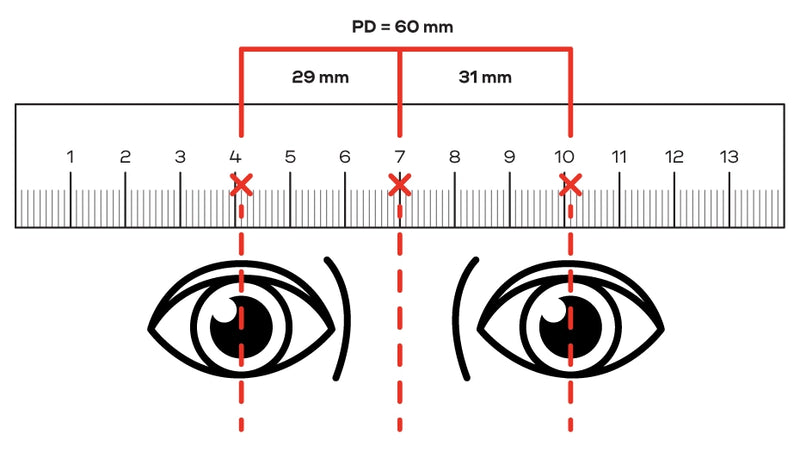
Hold the ruler against your forehead and mark on it with a pen the position of both pupils and the centre of the bridge of your nose.
Then measure a separate value for each eye: how far the centre of the pupil is from the centre of the bridge of your nose. The measurement is always given in millimetres.
Note: The value can differ between the eyes, but rarely by more than 3 mm.
🤓 More about the PD value
PD stands for pupillary distance. The value is used to grind the lenses so that their optical centres line up exactly with your pupils.
For an adult, the combined PD of both eyes is usually 54–74 mm, that is, about 27–37 mm per eye.
For progressive glasses it's important to measure PD separately for each eye, because the distances for the right and left eye are often not exactly the same. That way the viewing zones of the progressive lenses align correctly.
Still wondering about something? Send us a message: info@banaanieyewear.fi – there are no stupid questions! 🍌